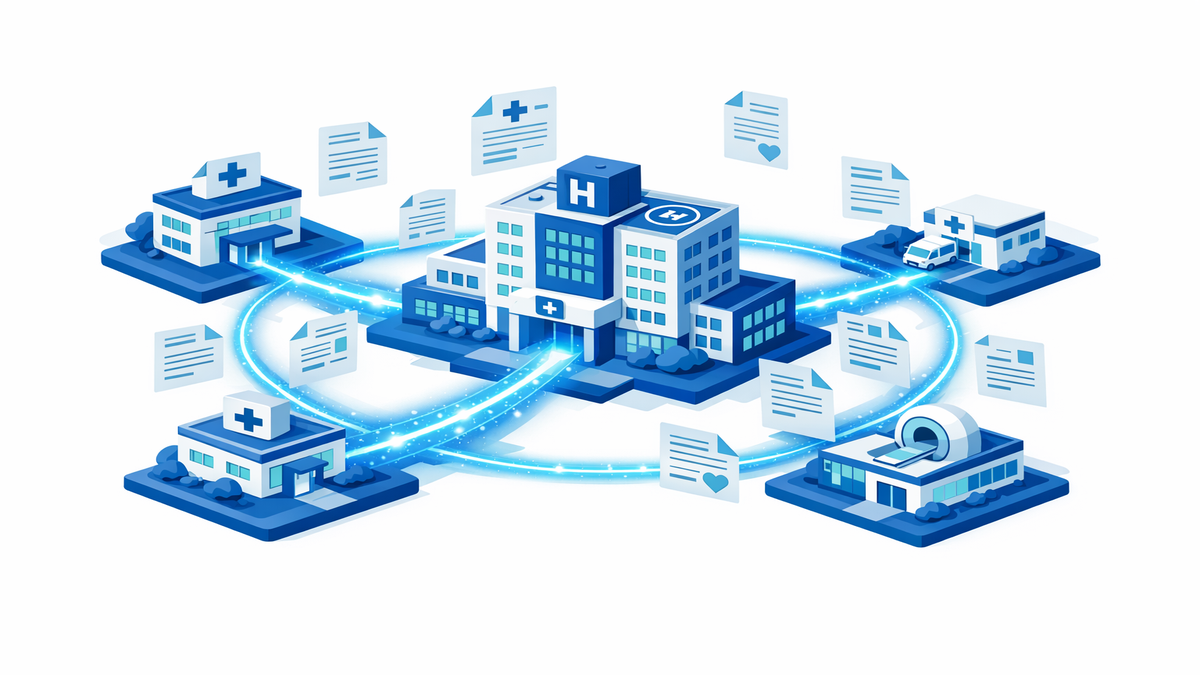
FHIR is a modern way for healthcare computer systems to share information with each other. It stands for Fast Healthcare Interoperability Resources, but you do not need to remember the full name to understand why it matters. In plain English, FHIR helps your doctor’s office, hospital, lab, imaging center, pharmacy, and patient app “speak the same language” when they exchange health records. The goal is simple: make it easier for the right medical information to show up in the right place at the right time.
For patients and caregivers, this matters because healthcare often happens in more than one location. You may get blood work at one lab, an X-ray at another facility, and follow-up care at a specialist’s office across town. Without a good way to share records, important details can be delayed, duplicated, or misunderstood. FHIR is one of the tools healthcare organizations use to make those handoffs smoother, so your care team can see more of the full picture.
What FHIR actually means in everyday care
Think of FHIR as a set of clear rules for packaging and sending health information. Instead of one office storing data in a format that another office cannot easily read, FHIR helps turn that information into smaller, organized pieces called “resources.” A resource might be a medication list, a lab result, an allergy, a vaccine record, or a radiology report. Because the information is arranged in a standard way, different systems have a better chance of understanding it correctly.
This does not mean every hospital or clinic suddenly uses the exact same computer system. In reality, many healthcare organizations use different electronic health record platforms, billing tools, and patient portals. FHIR helps bridge those differences by creating a common method for exchanging data. That can make it easier for a receiving office to pull in your records without manually retyping everything or relying on faxed pages that are hard to search.
FHIR is also designed for modern digital tools, including mobile apps and patient portals. That means it can support features like viewing your test results on a phone, sharing records with a new doctor, or connecting a health app to your medical chart when appropriate. For patients, the practical benefit is not the technology itself, but the possibility of fewer gaps in communication. When information moves more cleanly, your care can feel more connected.
- Labs can be shared with dates, values, and reference ranges.
- Imaging results can travel with the report and related details, not just a brief note.
- Medication lists can be updated more consistently across offices.
- Allergies and conditions can be easier for new clinicians to review.
Why hospitals and clinics are adopting FHIR
Hospitals adopt FHIR because patients expect healthcare information to move more easily than it did in the past. People are used to banking, travel, and shopping apps sharing information quickly and securely, so it can feel frustrating when medical records do not follow them between appointments. Healthcare is more complex and more regulated, but the expectation is still reasonable: if you already had a test done, your next doctor should be able to see it. FHIR helps organizations work toward that goal.
Another reason is efficiency. When records do not transfer well, staff may spend time calling other offices, scanning paper records, faxing reports, or manually entering information into the chart. That takes time away from patient care and increases the chance of errors. By using a more standard way to exchange data, hospitals can reduce some of that extra work. Over time, that can support faster scheduling, better follow-up, and less repeated paperwork for patients.
FHIR also supports better coordination across large health systems and community providers. A patient may see a primary care doctor, several specialists, a physical therapist, and a hospital team all within the same year. If each setting has only part of the story, important context can be missed. Sharing information in a structured way helps each clinician understand what happened before, what tests were done, and what the next steps should be.
- It can reduce duplicate testing when recent results are already available.
- It may improve transitions between the hospital, specialist care, and primary care.
- It helps patient-facing apps and portals show more complete information.
- It supports clearer record sharing when you change doctors or health systems.
How your labs and imaging can follow you without losing context
One of the biggest patient benefits of FHIR is that it can help test results travel with the details needed to interpret them. A lab number by itself is not always enough. Your doctor also needs to know when the test was done, what units were used, what the normal range was, and sometimes why the test was ordered. FHIR is built to carry that context along with the result, which makes the information more useful when it reaches another office.
The same idea applies to imaging such as X-rays, CT scans, MRIs, mammograms, or ultrasounds. It is not enough to know that “an MRI was done.” The receiving clinician may need the radiologist’s report, the body part imaged, the date, and any comparison to prior scans. When imaging information is shared in a structured format, the next doctor has a better chance of understanding what was found and what follow-up was recommended.
This can be especially helpful if you are seeing a new specialist or getting care after an emergency room visit. Instead of starting from scratch, the new team may be able to review your recent results sooner. That can reduce repeated questions, unnecessary repeat tests, and delays in treatment planning. It also helps preserve the story around the result, which is often just as important as the result itself.
For caregivers, this matters because managing records for a loved one can be overwhelming. If an older parent or a child with ongoing medical needs sees multiple providers, keeping everything organized is a major task. Better interoperability, which means systems working together, can ease some of that burden. It does not remove the need to stay involved, but it can make the information trail easier to follow.
- Ask whether your doctor can access outside lab and imaging records electronically.
- Keep the date and location of important tests in your own notes.
- Use the patient portal to review whether results appear complete and correctly labeled.
- Bring copies or screenshots of key reports if you are seeing a new provider soon.
What patients may notice when FHIR is working well
You may not hear the word FHIR during a clinic visit, but you may notice its effects. Your doctor may already have your recent hospital discharge summary, your specialist may be able to see blood work from another office, or your medication list may update more smoothly in the portal. You might also be able to connect a trusted health app to your records without filling out as many forms. These small conveniences can add up to a more coordinated care experience.
Another sign is fewer requests to repeat information that should already be in the chart. You will still be asked to confirm key details for safety, such as allergies or current medicines, but ideally the record is more complete from the start. That can make visits more focused and less frustrating. It also helps caregivers spend less time acting as the only bridge between disconnected offices.
Even with FHIR, record sharing is not always perfect. Some organizations are farther along than others, and not every type of information moves equally well. One office may receive your lab values but not the full note explaining the care plan, or a portal may show a report but not the actual image. Progress is real, but it is still normal to run into gaps, especially when care crosses different health systems.
- Review your medication list at every visit and mention anything missing or outdated.
- Check that outside test results are attached to the correct date and provider.
- Tell your care team where recent care happened so they know what records to request.
- Save important reports in a personal folder in case electronic sharing is delayed.
How to make the most of interoperable records in your own care
Even as healthcare technology improves, patients and caregivers still play an important role. Start by signing up for your patient portal if one is available. Portals often let you view test results, medication lists, visit summaries, and referrals, which can help you spot missing information early. If you use more than one health system, keep a simple list of your doctors, pharmacies, major diagnoses, surgeries, and recent tests.
Before an appointment with a new provider, gather the basics that help records match correctly. That includes your full name, date of birth, past names if relevant, and the names of the facilities where you had recent care. If you know the dates of key imaging studies or lab work, write them down. This can help office staff find the right records faster, even when electronic exchange is available.
It is also smart to ask direct questions. You can ask, “Can you see my outside labs?” or “Did the MRI report come through with the radiologist’s notes?” These are practical questions, not technical ones, and they can uncover missing pieces before the visit ends. If something important is not there, ask the office what is needed to request it and whether you can upload or bring a copy.
In the long run, FHIR is part of a larger shift toward more connected, patient-centered care. It is not magic, and it does not fix every record problem overnight. But it does give healthcare organizations a better way to exchange information so your history, tests, and treatment plans are less likely to get lost between offices. For patients, that can mean less repeating, less waiting, and a better chance that each clinician sees the context behind your care.
- Use your portal regularly instead of waiting until something goes wrong.
- Keep a personal record of major tests, diagnoses, and procedures.
- Ask whether your providers participate in electronic record sharing.
- Speak up if a result, report, or medication seems to be missing.
- Bring key documents to high-stakes visits, such as specialist consults or surgery planning.