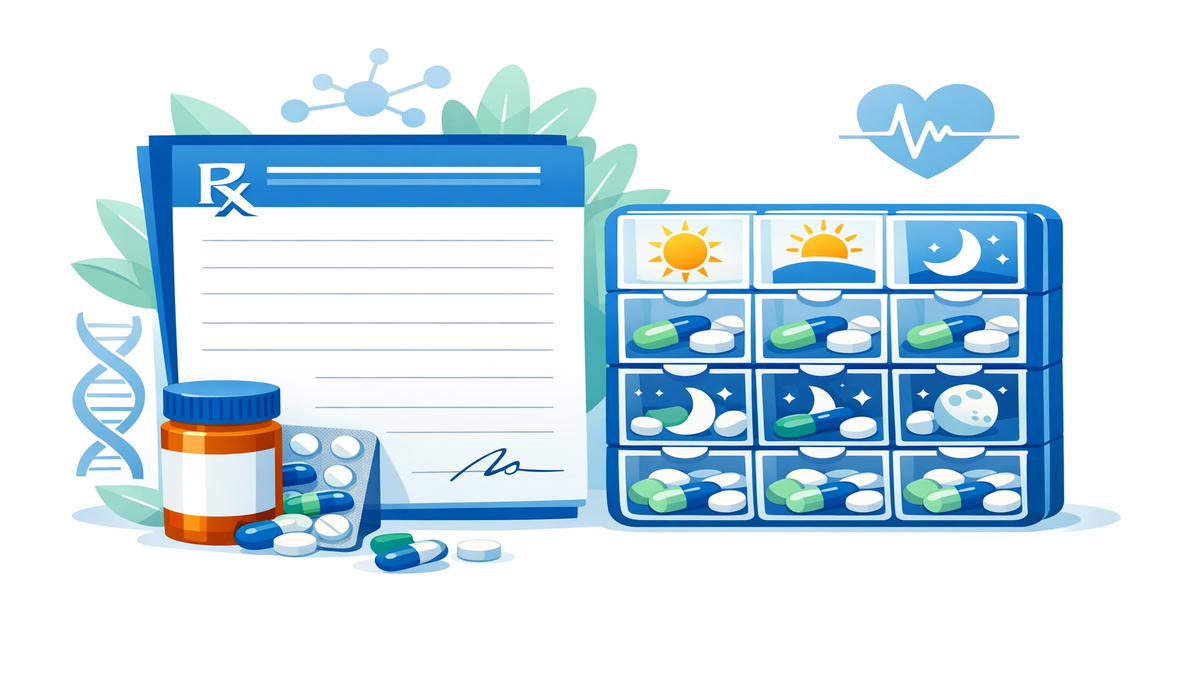
Prescription abbreviation quiz for medication literacy.
Prescription abbreviations are shorthand that clinicians and pharmacists use every day — but they can be confusing or even dangerous if misunderstood. Knowing what BID, PRN, NPO, and similar terms mean helps you take your medications correctly, ask the right questions at the pharmacy, and catch potential errors before they matter. This quiz covers eight of the most common "sig" codes found on prescription labels and instructions. Always double-check dosing instructions with your pharmacist if you are ever unsure.
Interactive Quiz0/8 answered
Question 1 of 8
A prescription says "take 1 tablet BID." This means:
Explanation:BID = bis in die (Latin), meaning twice a day. Typical times are morning and evening, spaced roughly 12 hours apart.
Question 2 of 8
TID on a prescription means:
Explanation:TID = ter in die, three times a day. Your pharmacist can advise on ideal timing to maintain steady drug levels.
Question 3 of 8
The direction "QHS" means take the medication:
Explanation:QHS = quaque hora somni, meaning at bedtime. Often used for sleep aids, pain medications, or drugs that cause drowsiness.
Question 4 of 8
"Take PRN for pain" means:
Explanation:PRN = pro re nata, as needed. You take PRN medications only when symptoms appear, not on a set schedule.
Question 5 of 8
A patient is told NPO before surgery. This means:
Explanation:NPO = nil per os (nothing by mouth). Fasting reduces the risk of aspiration under anesthesia. Your team will specify how long.
Question 6 of 8
"Take medication AC" means:
Explanation:AC = ante cibum, before meals. Some medications work better or reduce stomach upset when taken before eating.
Question 7 of 8
"Take medication PC" means:
Explanation:PC = post cibum, after meals. This is common for medications that should be taken with food to reduce GI irritation.
Question 8 of 8
A prescription says "QID while awake." This means:
Explanation:QID = quater in die, four times a day. "While awake" means you divide those doses across waking hours — not during sleep.